

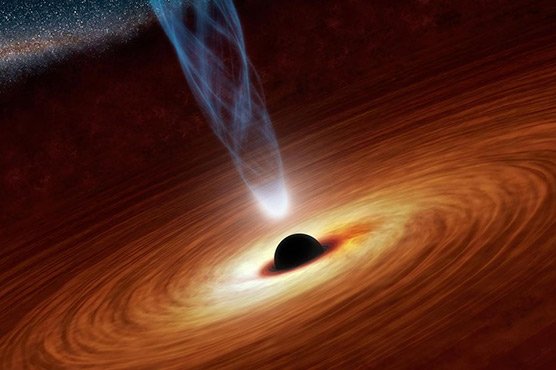
Our first picture of a black hole was a huge moment for science. But we can’t stop there. We need better pictures that deliver more information. That’s how we’ll learn even more about these strange, rule-breaking behemoths.
Now a group of astronomers from the Radboud University in the city of Nijmegen, Netherlands, along with the European Space Agency and other partners, are developing a plan to get much sharper pictures of black holes.
The Event Horizon Telescope’s (EHT) first picture of a black hole was a scientific triumph and a feat of cooperation, engineering, and technology. Throw in our species’ innate curiosity about nature, too. It’s a potent, effective mix.
But, the picture was kind of blurry, wasn’t it? It’s still a triumph, and lots of research and new papers will result from it. But could it be even better?
The group of scientists has a plan for launching radio telescopes into space to get clearer images of black holes. They’ve published a paperin the journal Astronomy and Astrophysics detailing their plans. Their end goal? To test Einstein’s Theory of General Relativity, again.
The EHT is a group of radio telescopes around the world operating in conjunction with each other. They work on the principle of interferometry.
Together, the ‘scopes act like a kind of virtual telescope the size of the Earth. That’s how we got a telescope large enough to see a black hole. But the EHT is hampered by the same thing as other terrestrial telescopes: Earth’s atmosphere.
Earth’s atmosphere can create a lot of problems for astronomers. Telescopes have to somehow adapt to the atmosphere to gather images of objects at great distances. That’s why telescopes are built in special locations: ideally in arid environments at high altitude.
The EHT’s radio telescopes are in high altitude locations around the globe. They’re in the Alps, in the Sierra Nevada, in Atacama, and in Hawaii. But they’re still limited by Earth’s atmosphere. And that atmosphere prevents the highest-frequency radio waves from reaching the ‘scopes.
There’s another limiting factor for the effectiveness of the EHT: the size of the Earth. On Earth we can only use interferometry to link scopes no further apart than the “width” of the Earth. So any virtual telescope is limited by the size of our planet itself.
The authors of the paper have a solution to both the atmosphere problem and the Earth-size problem. Put radio telescopes in place.
They call their proposed project the Event Horizon Imager (EHI), and they say that it can produce images of black holes five times sharper than the EHT.
The idea is to put two or three satellites in orbit that would act as radio observatories. Out there, they would be free of both of the EHT’s limitations.
“There are lots of advantages to using satellites instead of permanent radio telescopes on Earth, as with the Event Horizon Telescope (EHT),” says Freek Roelofs, a PhD candidate at Radboud University and the lead author of the article.
“In space, you can make observations at higher radio frequencies, because the frequencies from Earth are filtered out by the atmosphere. The distances between the telescopes in space are also larger. This allows us to take a big step forward.
We would be able to take images with a resolution more than five times what is possible with the EHT.”
The team created simulated images of black holes that represent what the EHI would be able to see.


