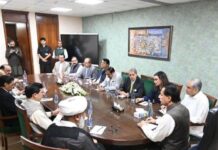

The Supreme Court of Pakistan on Wednesday delivered a detailed decision on the Practice and Procedure Act case, stating that the chief justice does not possess the unilateral authority to make decisions.
CJP Qazi Faez Isa in 21-page issued judgment, asserted that the constitution does not confer upon the top judge the power to act alone in making decisions under the Practice and Procedure Act.
The judgment also stated a divided bench, with Justices Muzahir Naqvi, Ayesha Malik, and Shahid Waheed opposing the notion of sharing powers with the Chief Justice.
Notably, six judges disagreed on the legal provision of Article 184 III, which grants the right of appeal against decisions. Ultimately, a majority decision of 6-9 deemed the right of appeal constitutional.
CJP highlighted the dissenting voices, including Justice Ejazul Hasan, Justice Muneeb Akhtar, and Justice Yahya Afridi, who supported the right of appeal.
The decision outlined that among those in favour of granting the right of appeal were Chief Justice Qazi Faez Isa, Justice Sardar Tariq Masood, Justice Mansoor Ali Shah, Justice Aminuddin Khan, Justice Jamal Khan Mandukhel, Justice Athar Minallah, and Justice Musrat Hilali.
However, the judgment makes it clear that the Constitution does not grant unlimited powers to the Supreme Court.
The court asserted that legislative power rests with Parliament, emphasising the need for mutual respect between institutions. It stressed that the Supreme Court should not substitute its opinion for that of Parliament.
Underlining the significance of the Practice and Procedure Act, the ruling stated that it would enhance transparency and access to justice. A committee comprising the Chief Justice and two senior judges would empower the judiciary further.
The Act’s provision for the right of appeal under Article 184/3 was deemed a Sharia requirement and aligned with international legal norms.
Justice Qazi Faez Isa explicitly stated that the Constitution does not designate the Chief Justice as the “master of rosters,” emphasising that the term “master” is derogatory in a democratic constitution.
The judgment argued that such terminology contradicts constitutional and Sharia principles, reflecting a mindset akin to slavery
The ruling concluded by asserting that decisions of the Supreme Court apply to other courts but not to the Supreme Court itself.
It clarified that decisions of larger benches prevail over those of smaller benches, and constitutional traditions cannot be applied arbitrarily to the style of law.
,,,,,,,,,,,,,,,,,,,,,,,,,,,,,,,,,,
The Supreme Court on Wednesday dismissed the petitions against the Practice and Procedure Act, and sustained the law with a majority of 10-5.
A full court bench comprising 15 judges, head by Chief Justice of Pakistan Qazi Faez Isa, pronounced the judgement that was reserved earlier in the day after five consecutive hearings.
The Supreme Court had reserved its decision on the applications against the Practice and Procedure Act. Chief justice of Pakistan (CJP) Qazi Faez Isa said if a consensus is reached, the verdict will be pronounced, otherwise it will be reserved.
The Supreme Court has resumed the hearing of multiple petitions against the Practice and Procedure Act for the fourth consecutive day. A full court bench of the Supreme Court, headed by Chief Justice of Pakistan (CJP) Justice Qazi Faez Isa, is hearing the petitions.
On Tuesday, the MQM and Pakistan Bar Council had announced their support for the Practice and Procedure Act.
Under Article 175, legislation regarding the Supreme Court is not possible, petitioner’s counsel Hassan Irfan remarked.
Justice Jamal Mandokhel said if the law sustained the full court could amend rules. Justice Ayesha Malik said the full court rules could also not be made outside the law.
Beginning his arguments, Attorney General for Pakistan Mansoor Usman Awan said he would take about Article 191 and the independence of the judiciary.
He further said the Constitution mentions “subject to law” at various places, adding the right to privacy is also kept subject to law. Article 191 does not take away the right of parliament to legislate, he argued.
Parliament has given independence to the judiciary but has not rescinded its right to legislate, the AGP added.
There has been no amendment to Article 191 since the Constitution was made, he commented, adding that not amending Article 191 was to ensure the independence of the judiciary.
He further said that the right to legislation in the high treason and Right to Information laws was derived from constitutional provisions.
If parliament did nothing under Article 191 since 1973, it could mean that it accepted that the article did not allow for further legislation, Justice Muneeb Akhtar remarked.
Justice Athar Minallah told the AGP that Article 191 did not just say law, but “subject to law”.
The chief justice of Pakistan said subject to law could also mean judgement law. Maybe parliament maintained these words this way for further legislation.
Wherever this was the intention of parliament, this further legislative power has been clarified, Justice Ijazul Ahsan remarked, adding if this was the intention of parliament in Article 191 also, it would have said so.
The AGP responded that the term “law” in Article 191 was not related to the 1956 Rules. Justice Muneeb Akhtar asked if the Supreme Court rules made in 1980 be called the current law. AGP Awan responded in the negative.
Justice Ayesha Malik asked Awan if he was saying that the rules have the status of law but under Article 191 this isn’t law.
Justice Muhammad Ali Mazhar asked if after the formation of the Supreme Court rules the word “law” in Article 191 ceases to exist. The AGP said Article 191 does not place any bar on parliament for amendments.
“You are saying that there is no restriction on parliament to make amendments under the rules made by the Supreme Court?” Justice Ahsan questioned, asking further if there is also no restriction on amendments made by the Supreme Court in the law made by parliament.
The law-making body is parliament, the AGP responded.